
World Cup 2026 Prop Bets — Creative Markets Beyond Match Results
 Available in US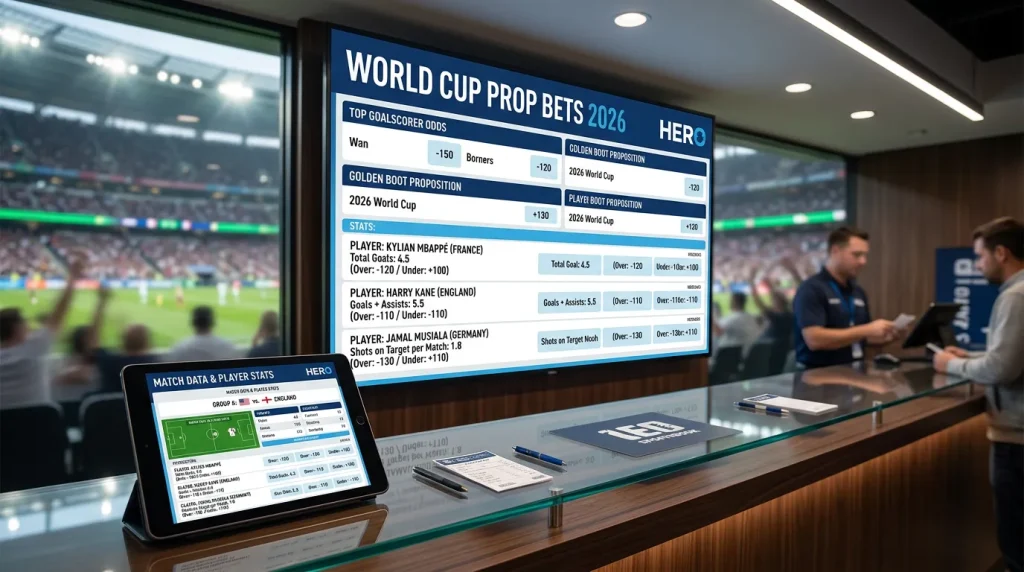
Table of Contents
The match ended 0-0. Germany and Spain played to a dull stalemate in the Euro 2024 group stage, and bettors who backed either side to win or the over on goals went home empty-handed. But I profited that afternoon. My prop bets — Rodri to commit 2+ fouls, Germany corner kicks over 4.5, both teams to receive yellow cards — all hit. The scoreline that disappointed millions of conventional bettors was irrelevant to my positions because World Cup 2026 prop bets operate in parallel markets where match outcomes matter less than individual events within matches.
Proposition betting opens creative angles that moneyline and spread bettors cannot access. The 2026 World Cup, with its expanded 104-match format across thirty-nine days, offers more prop betting opportunities than any previous tournament. Player performances, team statistics, tournament milestones, and novelty markets combine to create a landscape where edge exists for bettors willing to do the specific research that bookmakers cannot justify on low-volume markets. This analysis covers where prop value hides and which prop traps to avoid.
Player Prop Bets — Goals, Assists, Cards
Player props break individual performances into quantifiable outcomes independent of team results. The value opportunity is substantial because bookmakers must price hundreds of players across forty-eight teams, often relying on automated models rather than match-specific analysis. Bettors willing to research individual matchups can identify systematic mispricing.
Anytime goalscorer markets receive the most attention among player props. The bet is simple: will a specific player score at least one goal in a match? Prices typically range from 2.00 for elite strikers to 15.00 or higher for defenders and goalkeepers. The edge comes from identifying situations where scoring probability exceeds what the price implies.
I target anytime scorer value in mismatch matches where favourites will create numerous chances against weak opposition. Brazil’s attacking players against Haiti represent obvious opportunities, but the obvious opportunities are often priced efficiently. The subtler value appears in secondary attackers who benefit from defensive attention on primary threats. If Vinícius Jr. prices at 1.60 to score, defensive focus will shift to him, creating space for Rodrygo at 2.80 or Raphinha at 3.20. The secondary attacker scores nearly as often in these mismatches while offering substantially better prices.
Assist props have become more prominent in recent tournaments as bookmakers expand their offerings. Prices typically range from 3.00 to 5.00 for creative midfielders and full-backs. The challenge is that assists require both a chance creation and a teammate’s finish — two independent events that must both occur. This makes assist props inherently higher variance than goalscorer props. I target assist props only on players with extremely high chance creation rates, like Kevin De Bruyne or Bruno Fernandes, in matches where their teams are heavy favourites expected to score multiple goals.
Card props — yellow and red cards — offer entirely different dynamics. Bookmakers price player cards based on historical disciplinary records and position, but these factors explain only part of card variance. Match context matters enormously. A defensive midfielder in a tight knockout match faces different card probability than the same player in a dead-rubber group stage fixture. Referees assigned to matches with historical tensions — England vs. Argentina, for instance — tend to show more cards. Temperature and kickoff time affect disciplinary patterns, with evening matches in hot conditions producing more fouls of frustration.
The specific value in card props comes from identifying players whose role in specific matches will generate fouls. Holding midfielders tasked with stopping elite attackers — imagine Declan Rice marking Kylian Mbappé — commit tactical fouls at predictable rates. Full-backs defending against pacy wingers get caught ball-watching and shirt-pulling. Aggressive centre-backs against physical strikers accumulate challenges that lead to bookings. When the price on a player’s yellow card reaches 3.00 or higher in a match where their assignment virtually guarantees fouling, value exists.
Team Props — Clean Sheets, Corners, Group Finishing
Team prop markets aggregate performance across starting elevens rather than focusing on individuals. These markets often feature tighter bookmaker margins than player props because they receive higher betting volume, but inefficiencies still emerge in specific match contexts.
Clean sheet betting asks whether a team will concede zero goals. Prices range from approximately 2.00 for elite defensive sides against weak opposition to 5.00 or higher for attacking teams with porous backlines. The edge appears in matches where defensive matchups favour one side’s organization against another’s attacking style. Italy’s defensive structure historically neutralizes possession-based teams that lack direct attacking threats. Spain’s high press creates turnovers but leaves space behind for rapid transitions. Identifying these stylistic mismatches informs clean sheet positioning.
For 2026, I see clean sheet value on Germany against Curaçao and Ivory Coast, where German defensive organization should contain limited attacking quality at prices around 1.80 to 2.20. Morocco offers clean sheet value in Group C, where their 2022 defensive performance against elite opposition suggests they can contain Scotland and Haiti while potentially limiting Brazil to one goal. The Morocco clean sheet against Brazil at 5.00 or higher represents speculative value given their proven ability to defend deep against quality possession teams.
Corner kick props have gained popularity as bettors recognize the statistical reliability of these markets. Unlike goals, which feature high variance based on finishing quality and goalkeeper performance, corners reflect sustained attacking pressure that is more predictable from possession and chance creation data. Teams averaging 7.0 corners per match at club level tend to produce similar numbers at international level in comparable match contexts.
The value in corner props comes from identifying possession mismatches where dominant teams will attack repeatedly against packed defences. Brazil against Haiti might see Brazil win 10-12 corners as Haiti retreats to a deep block and clears repeatedly. The corner total line will sit around 10.5 or 11.5; positioning on the over in these mismatches tends to profit. Conversely, matches between two possession-oriented teams — Spain vs. Japan, for instance — often produce fewer corners than total lines suggest because both sides retain the ball rather than forcing clearances.
Group finishing props — team to top group, team to finish bottom — price the aggregate of three matches rather than individual results. Value appears when the market misprices competitive balance within groups. Group F (Netherlands, Japan, Tunisia, Sweden) features four teams of comparable quality, meaning any finishing order is plausible. At typical prices of 1.80 for Netherlands to top the group, the implied 55% probability overstates Dutch certainty given Japan’s demonstrated ability to beat elite opposition. Japan to top Group F at 4.50 or higher offers speculative value that materializes if the Dutch stumble in any fixture.
Tournament Props — Total Goals, Extra Time, Penalties
Tournament-wide props aggregate outcomes across all 104 matches, creating markets with massive sample sizes but correspondingly difficult analysis. Bookmakers have decades of historical data informing their lines. Finding edge requires identifying where the expanded 48-team format changes historical patterns.
Total tournament goals lines will sit around 260 to 280 goals, implying 2.5 to 2.7 goals per match. The expanded format introduces more mismatches than previous tournaments — debutants like Haiti, Curaçao, and Cape Verde facing elite opposition — which should inflate scoring. My model suggests over on tournament goals offers slight value if the line sits at 265 or below. At 275 or above, the value disappears or shifts to under.
Extra time matches — how many knockout matches will require more than ninety minutes — present a quantifiable historical pattern. Approximately 40% to 50% of World Cup knockout matches reach extra time, with the percentage rising in later rounds where quality compression produces tighter matches. The 2026 format features sixteen Round of 32 matches, eight Round of 16 matches, four quarter-finals, two semi-finals, a third-place match, and a final — thirty-one knockout matches total. Expect twelve to fifteen extra time matches based on historical rates. If lines sit at 10.5 or 11.5, over represents value.
Penalty shootout props ask how many knockout matches will be decided from the spot. Historical rates suggest 20% to 25% of extra time matches proceed to penalties. Across roughly fourteen extra time matches, expect three to four penalty shootouts. Lines sitting at 2.5 likely price over as slight value; lines at 3.5 price under as value. The variance is high — shootout frequency varies significantly tournament to tournament — so stake sizing should reflect the uncertainty.
Novelty props — will there be a hat-trick in the tournament, will a goalkeeper score, will a match feature 7+ goals — attract recreational money and are priced accordingly. I avoid these markets because bookmakers maintain massive margins and the outcomes depend on rare events that defy systematic analysis. A goalkeeper scoring happens roughly once per twenty World Cups. Pricing that at 50.00 might seem appealing, but the true probability is closer to 2% to 3%, making the bet negative expected value despite the long odds.
Canada Prop Bets — What’s Available
Canadian-specific prop bets deserve dedicated attention given the local readership. The home advantage across all three group matches creates prop opportunities unique to this tournament, and Canadian sportsbooks will offer extensive markets on the host nation.
Jonathan David anytime scorer props in individual matches represent the most actionable Canada bets. David has scored consistently at club level and will be the focal point of Canadian attacks. Against Bosnia and Herzegovina, David prices around 2.40 to score anytime. Against Qatar, expect similar pricing. Against Switzerland, the price stretches to 2.80 or higher given Swiss defensive quality. I consider David value at any price above 2.50 in matches where Canada is expected to create multiple chances.
Alphonso Davies assist props offer value given his role as an attacking full-back who delivers crosses and through balls into the box. Davies will play higher up the pitch than his Bayern Munich positioning suggests, given Canada’s need to maximize their best player’s influence. Assist prices around 4.00 to 5.00 per match represent fair value when Canada faces opponents they should dominate — Bosnia and Qatar specifically.
Canada clean sheet props are tricky. Canadian defensive organization has improved under Jesse Marsch, but the backline lacks the individual quality to consistently shut out opponents. Clean sheet against Bosnia at 2.40 to 2.80 offers marginal value given home advantage. Clean sheet against Switzerland at 4.00 or higher is not value given Swiss attacking quality. Avoid Canada clean sheet against Qatar — the Qataris struggled in their own World Cup but possess the individual skill to score against anyone on their day.
Canada total goals props — over/under on Canadian tournament scoring — will price around 3.5 to 4.5 goals across the group stage. If Canada advances, additional knockout matches add opportunity. Over 4.5 tournament goals at plus money represents the value position if you believe Canada wins at least one group match convincingly and competes in others. Under 3.5 tournament goals prices Canadian disappointment at plus money if you believe their attack will struggle against organized defences.
Prop Betting Strategy for a Long Tournament
Thirty-nine days of World Cup 2026 prop bets demands bankroll discipline that shorter tournaments do not require. The volume of opportunities creates temptation to overbet, chasing action on every kickoff. Resist this temptation. Sustainable prop betting requires selectivity.
I allocate no more than 10% of my tournament betting bankroll specifically to prop bets. Within that allocation, no single prop receives more than 0.5% of total bankroll. This discipline ensures that the inevitable losing streaks — which happen more frequently on high-variance props than on match outcomes — do not destroy profitability. A string of ten losing player props at 0.5% stakes costs 5% of prop allocation, painful but recoverable. The same string at 2% stakes costs 20%, potentially unrecoverable.
Tracking prop results across the tournament reveals patterns that inform late-tournament adjustments. If corner props consistently over-perform expectations in the first week, the line-setting process may be systematically undervaluing attacking intent in the expanded format. If clean sheet props consistently fail because weaker teams are scoring consolation goals, adjustment downward on clean sheet value is warranted. The tournament itself is a data source that refines probability estimates as matches unfold.
Line shopping matters more for props than for standard markets. Prop margin varies dramatically by bookmaker — one shop might offer Vinícius Jr. to score at 1.70 while another offers 1.55. The difference represents 15% of stake on a single bet. Maintaining accounts at multiple regulated Canadian operators allows capturing best available prices. For detailed prop odds comparison, reference the complete World Cup betting guide covering operator-specific offerings.
World Cup 2026 prop bets reward research, discipline, and selectivity. The markets are wider than ever before, offering opportunities that previous tournaments could not match. Approach these opportunities with the same rigor applied to match outcomes, and the thirty-nine days will provide steady profit potential alongside the main event.
