
World Cup 2026 Parlay Picks — Multi-Bet Strategies for the Tournament
 Available in US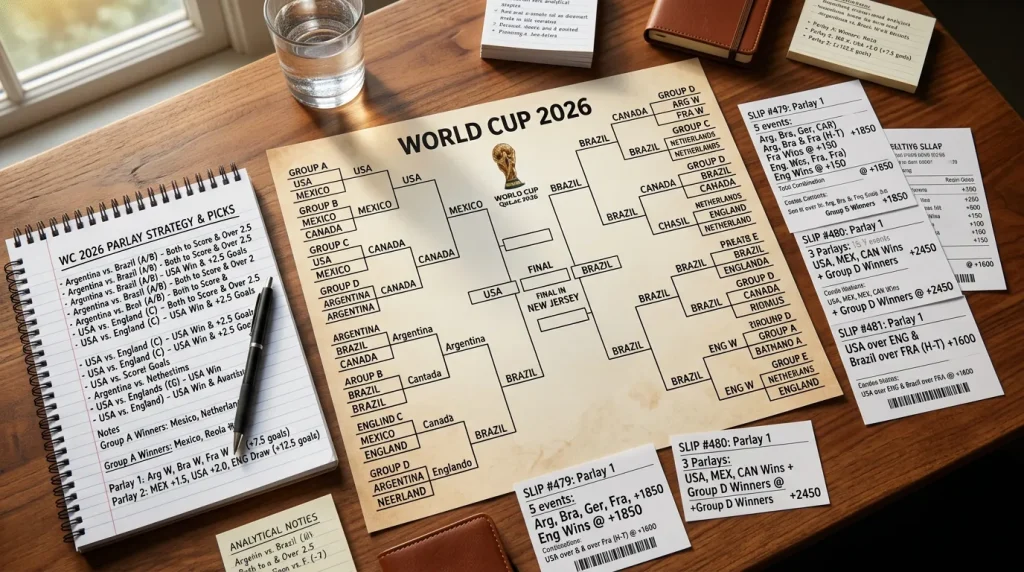
Table of Contents
The first parlay I ever placed was on the 2014 World Cup. Germany, Netherlands, and Argentina all to advance from their groups. Simple enough, three heavy favourites, odds of roughly 1.80 combined. It hit. The second parlay I placed was slightly more ambitious: Germany to beat France, Brazil to beat Colombia, combined at 3.50 odds. Brazil collapsed, losing 7-1 to Germany in the semi-final after Colombia was already eliminated, and my lesson in parlay hubris began.
World Cup 2026 parlay picks demand respect for variance. Thirty-nine days of tournament football will feature at least half a dozen results that seemed impossible beforehand. Japan beating Germany in 2022. Saudi Arabia beating Argentina in 2022. South Korea beating Germany in 2018. Each of these outcomes would have destroyed any parlay including the favourite. The tournament format expands in 2026, meaning more matches, more variance, and more opportunities for even the most confident predictions to collapse.
I approach parlays differently now. They serve specific strategic purposes rather than functioning as lottery tickets. A well-constructed parlay can hedge risk, lock in profit across correlated outcomes, or provide outsized returns on scenarios where the individual legs genuinely connect. The worst parlays combine unrelated outcomes at short odds, paying the house edge multiple times for no strategic benefit. This analysis will help you construct World Cup 2026 parlays that make mathematical sense alongside emotional sense.
How Parlays Work in World Cup Betting
A parlay — called an accumulator in European markets and a multi-bet in Australian terminology — combines multiple selections into a single wager. All selections must win for the parlay to pay. The odds multiply together, creating larger potential returns than any individual leg would offer. The catch, of course, is that one failed selection kills the entire bet.
The mathematics are straightforward but often misunderstood. If you parlay three outcomes each priced at 2.00 decimal odds, the combined price is 2.00 × 2.00 × 2.00 = 8.00. A $10 wager returns $80 if all three hit. Each leg at 2.00 implies a 50% probability of success. Three independent events each at 50% probability combine to 50% × 50% × 50% = 12.5% probability of winning the parlay. The 8.00 odds imply 12.5% probability, so a parlay of fair-odds selections at 2.00 returns a fair-odds parlay. The house edge enters through the individual leg pricing rather than the parlay mechanism itself.
Tournament football adds complexity because outcomes are often correlated. If Brazil beats Argentina in a knockout match, both “Brazil to advance” and “Brazil total goals over 1.5” become more likely simultaneously. If Germany tops their group convincingly, “Germany to reach semi-finals” and “Germany highest-scoring group stage team” both become more probable. Correlated parlays should theoretically offer lower combined odds than the multiplication would suggest, but bookmakers often fail to adjust fully. Finding correlated parlays priced as if the legs were independent represents one of the few genuine edges in parlay betting.
The house edge problem multiplies with each leg. If each selection carries a 5% house edge — typical for soccer matches — a two-leg parlay effectively carries 10% edge. A four-leg parlay carries 20%. A six-leg parlay carries 30%. This accumulated edge is why serious bettors generally avoid parlays of more than two or three legs. The mathematics simply do not favor complexity. If you insist on larger parlays, ensure each leg offers genuine value that offsets the compounding house edge rather than adding legs for excitement value.
Cash-out options on parlays deserve skepticism. Bookmakers offer early settlement when it benefits them more than you. The cash-out price typically includes significant margin reduction. A parlay with three legs hitting and one remaining will cash out at roughly 70% to 80% of what mathematical fair value would suggest. I almost never cash out parlays early, preferring to let them run or constructing hedges through separate wagers if risk management becomes necessary.
Group Stage Parlay Combinations
The twelve-group format creates natural parlay opportunities. Group stage outcomes feature lower variance than knockout matches because three matches rather than one determine qualification. Teams cannot be eliminated by a single poor performance. This structural reality makes group stage parlay combinations more reliable than knockout round parlays, though reliability remains relative in World Cup betting.
Favourite group winners parlay: Brazil, Germany, and Spain to top their respective groups. Brazil faces Morocco, Scotland, and Haiti in Group C — no serious competition for first place. Germany faces Ecuador, Ivory Coast, and Curaçao in Group E — similarly straightforward. Spain faces Uruguay, Saudi Arabia, and Cape Verde in Group H — Uruguay poses theoretical threat but Spanish quality should prevail. Each selection prices around 1.30 to 1.45. Combined, the parlay reaches roughly 2.20 to 3.00 odds. The probability of all three hitting exceeds what the combined odds suggest because each favourite faces limited competition and should progress comfortably. This parlay represents reasonable value for modest returns.
Host nations advancement parlay: Canada, USA, and Mexico all to qualify from group stage. Each host plays at least one group match in their own country. Home advantage for all three is real and quantifiable. Canada at 1.65 to 1.80 to qualify, USA at 1.20 to 1.30, Mexico at 1.15 to 1.25. Combined, the parlay prices around 2.30 to 3.00. The true probability of all three hosts advancing likely exceeds 50%, while the parlay odds imply 33% to 43%. This is one of the strongest parlay constructions available because the individual legs are appropriately priced and genuine value compounds.
Third-place advancement parlay: Two or three third-place finishers to advance to Round of 32. This parlay exploits the tournament format where eight of twelve third-place teams qualify. Identifying which groups will produce advancing third-place finishers requires analyzing group strength. Group F (Netherlands, Japan, Tunisia, Sweden) and Group L (England, Croatia, Panama, Ghana) feature quality throughout, meaning their third-place finishers should accumulate enough points and goal difference to advance as best thirds. Parlaying specific teams like Sweden third in Group F at 3.50 with Panama third in Group L at 4.00 creates a 14.00 combined parlay on plausible outcomes. High variance but mathematically defensible.
Group stage exact finishing order parlays: Brazil first, Morocco second in Group C. France first, Senegal second in Group I. Portugal first, Colombia second in Group K. Each exact order prices around 1.80 to 2.20. A three-leg parlay combining these outcomes reaches 5.80 to 10.60 combined odds. The value depends on whether the second-place finisher is correctly identified — Norway could challenge Senegal, Uruguay could challenge Colombia’s path. I consider this parlay moderate value because the first-place selections are nearly certain while the second-place selections carry reasonable probability.
Same-Game Parlays — Building Smart SGPs
Same-game parlays combine multiple outcomes from a single match. The bookmaker models correlation between legs and adjusts odds accordingly. A parlay of “Team A to win” and “Over 2.5 goals” will not pay the straight multiplication of individual odds because those outcomes are positively correlated. If Team A wins, the match is more likely to feature goals because winning teams score at least one.
The key to smart same-game parlays is identifying where bookmaker correlation models undervalue connection between outcomes. Two principles guide my approach: back correlated outcomes where correlation is underpriced, and combine outcomes that require similar match conditions to hit.
High-scoring match SGP structure: Over 2.5 goals + both teams to score + first half over 0.5 goals. These three outcomes require an open, attacking match with early goals. If the first leg hits (first half goal), the second and third legs become more likely because the match has established attacking intent. If both teams score, over 2.5 becomes probable. The legs reinforce each other. A typical Group E match like Germany vs. Ivory Coast might price this SGP at 2.80 to 3.50 combined. The true probability is higher than individual leg multiplication would suggest because the outcomes are tightly correlated.
Favourite dominance SGP structure: Favourite to win + favourite clean sheet + favourite over 1.5 goals. This parlay requires the favourite to control the match completely. Brazil vs. Haiti presents an ideal opportunity. Brazil winning at 1.20 is near-certain. Brazil clean sheet at 1.80 is likely given Haiti’s limited attacking quality. Brazil over 1.5 goals at 1.40 is probable given the talent disparity. Combined straight multiplication suggests 3.02 odds, but the SGP will price closer to 2.30 to 2.60 accounting for correlation. The value exists if the corrected price still exceeds your calculated probability for complete dominance.
Player-focused SGP structure: Star player to score + star player to be booked + team to win. This counterintuitive combination backs a player making significant impact on both ends. Attackers who press aggressively and draw fouls sometimes accumulate cards while also scoring. Kylian Mbappé anytime scorer + Mbappé to be booked + France to win prices expensively because bookmakers understand the correlation, but lesser-known players like Vinícius Jr. or Bukayo Saka in similar constructions occasionally offer value when their card probability is underestimated.
Avoid SGPs that combine unrelated outcomes. “Germany to win + over 10.5 corners + both goalkeepers to make 3+ saves” might price attractively, but the legs have no logical connection. You are paying correlation adjustments for outcomes that do not actually correlate, destroying whatever value might exist in individual legs.
Managing Risk in Tournament Parlays
Tournament parlay risk management begins with accepting a fundamental truth: most parlays lose. Three-leg parlays hit roughly 10% to 15% of the time even with well-selected legs. Four-leg parlays hit 5% to 8%. Six-leg parlays hit 2% to 3%. Your bankroll management must account for extended losing streaks before the inevitable winner arrives.
I allocate no more than 5% of my World Cup betting bankroll to parlays across the entire tournament. Within that allocation, no single parlay receives more than 0.5% of total bankroll. This discipline ensures that parlay variance cannot materially damage my overall World Cup betting position. If every parlay loses — possible given the math — I lose 5% of my tournament allocation. If two or three hit at reasonable odds, those wins more than offset the accumulated losses.
Staking strategy for parlays differs from straight betting. On a straight bet where I calculate 10% edge, I might stake 1% of bankroll. On a parlay where I calculate 10% edge across the combined outcome, I stake 0.25% to 0.5% because the variance is dramatically higher. The edge is the same, but the path to realizing that edge is rockier. Kelly criterion applications for parlays suggest stakes roughly one-third to one-half the level of equivalent straight bets for the same edge.
Hedging parlays mid-tournament requires careful calculation. If I have a three-leg parlay with two legs already won, the remaining leg effectively becomes a straight bet at the combined parlay odds. I can choose to let it ride, cash out at reduced value, or place a counter-bet on the opposite outcome to lock in guaranteed profit. The third option — hedging — makes sense when the guaranteed profit from hedging exceeds the expected value of letting the parlay run. This calculation depends on the odds of the final leg and your risk tolerance for the all-or-nothing outcome.
A practical example: I have a $20 parlay at 8.00 combined odds, two legs have won, and the final leg is Germany to beat France in the quarter-final at 2.40. The parlay pays $160 if Germany wins. France is priced at 2.80 to win, with the draw at 3.40. I can bet $55 on France at 2.80, which pays $154 if France wins. If Germany wins, I win $160 from the parlay minus the $55 hedge, netting $105. If France wins, I lose the $20 parlay but win $154 from the hedge, netting $134. If the match draws, I lose both bets for -$75. The hedge locks in profit unless the draw occurs, reducing variance substantially. Whether this hedge makes sense depends on your assessment of draw probability and your preference for guaranteed returns versus maximum expected value.
Three Sample World Cup Parlays
These parlays represent my actual positions as we approach tournament kickoff. They are not recommendations — your risk tolerance and bankroll differ from mine — but they demonstrate how the principles above translate into concrete betting strategy.
Conservative group stage parlay: Brazil to qualify from Group C + Germany to qualify from Group E + England to qualify from Group L. Each leg prices around 1.08 to 1.15. Combined odds approximately 1.26 to 1.52. This parlay essentially locks in a small profit on the near-certainty that three powerhouse nations advance from weak groups. The expected value is modest but positive, and the psychological benefit of starting the tournament with a quick win helps establish momentum. I stake 1% of tournament bankroll on this parlay — larger than typical parlay stakes because the variance is minimal.
Moderate value parlay: Canada to qualify from Group B + Turkey to qualify from Group D + Morocco to finish top two in Group C. Each leg offers genuine value based on my probability assessments. Canada at 1.70 is underpriced given home advantage. Turkey at 2.30 is reasonable for the second-best team in a manageable group. Morocco at 1.45 is near-certain given Scotland and Haiti as competition. Combined odds approximately 5.70. If all three hit, the return is meaningful. If one fails, the loss is limited to 0.5% of bankroll. This parlay connects three outcomes I would bet individually anyway, capturing value across correlated nations in competitive but winnable groups.
High-upside speculative parlay: Germany to win World Cup + Canada to reach quarter-finals + Japan to top Group F. Germany at 13.00 for outright winner, Canada at 4.50 to reach quarters, Japan at 4.00 to top Group F. Combined odds approximately 234.00. A $10 bet returns $2,340. The probability of all three hitting is roughly 0.5% to 1%, but the price implies 0.4%. The small edge justifies a tiny speculative position. If Germany performs as my model predicts and Canada capitalizes on home advantage while Japan handles the Netherlands — all plausible outcomes — this parlay transforms a modest stake into tournament-defining profit. I stake 0.1% of bankroll on constructions like this, accepting near-certain loss in exchange for lottery-ticket upside. For understanding how these predictions connect to overall World Cup betting strategy, the interplay between straight bets, value plays, and speculative parlays creates a diversified tournament portfolio.
World Cup 2026 parlay picks reward patience and discipline more than creativity. The best parlays combine genuinely undervalued legs rather than exciting narratives. They respect bankroll management rather than chasing transformative wins. They account for correlation between outcomes rather than treating each leg as independent. Approach parlays as strategic tools rather than entertainment products, and the thirty-nine days of tournament football will offer plenty of opportunities to profit. Build your World Cup 2026 parlays thoughtfully, stake them appropriately, and accept that variance will determine short-term outcomes while edge determines long-term results.
