
Portugal at the 2026 World Cup — Odds and Analysis for Canadian Fans
 Available in US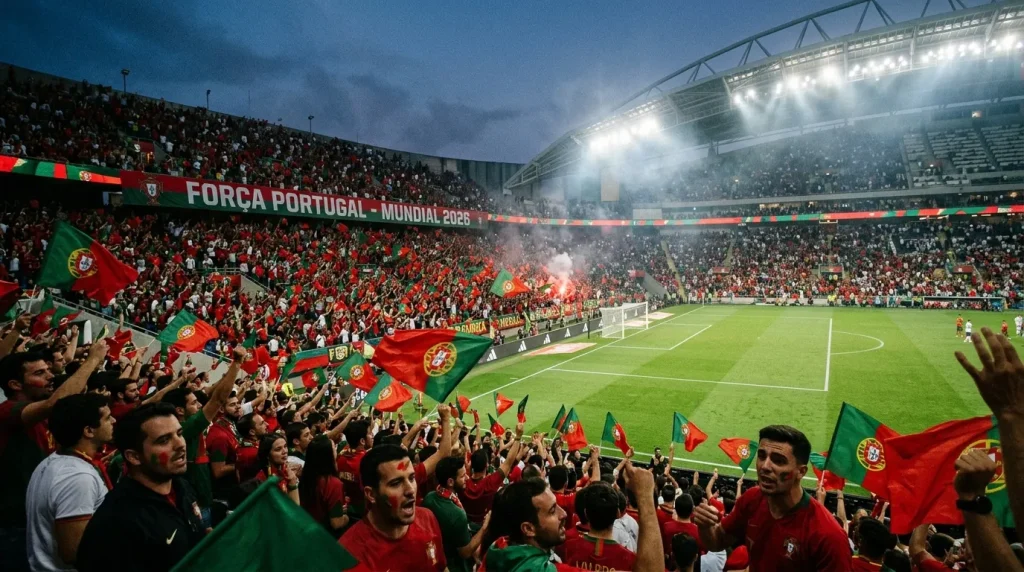
Table of Contents
On Dundas Street West in Toronto, between Ossington and Dovercourt, the Portuguese flag hangs from bakeries, barbershops, and the balconies of walk-up apartments. This stretch of the city — Little Portugal — is the spiritual centre of a diaspora that numbers over half a million across Canada. Portuguese-Canadians are one of the country’s largest immigrant communities, concentrated in Toronto, Montréal, and Vancouver, and their connection to the Seleção das Quinas is visceral. When Portugal play at a World Cup, Little Portugal erupts. Car horns, flag-waving processions on Dundas, packed cafés with espresso cups trembling on tabletops as penalties are taken. For Portuguese-Canadians, this is not a sporting event — it is an expression of identity.
That cultural intensity makes Portugal one of the most heavily bet-upon teams in the Canadian sportsbook market. The emotional investment of a half-million-strong community translates directly into betting volume, which in turn affects odds pricing and creates opportunities for both value and error. As an analyst, my task is to strip away the emotion and assess Portugal at the 2026 World Cup on data: squad quality, group difficulty, tactical setup, and where the markets are mispricing risk. The picture is more nuanced than the heritage crowd might hope.
Squad and Key Players
Portugal’s squad for 2026 sits at a generational crossroads. The Cristiano Ronaldo question dominates the conversation, just as the Messi question dominates Argentina’s. Ronaldo, now 41, continues to play professionally and score at a prolific rate in the Saudi Pro League, but the gap between Saudi league competition and World Cup intensity is enormous. His inclusion in the 2026 squad — if it happens — would be a selection decision driven partly by commercial and cultural factors rather than purely sporting ones. If Ronaldo plays, he will be a penalty-box presence who no longer presses, no longer tracks back, and no longer covers the ground he once did. The trade-off is his heading ability, his positioning for crosses, and the sheer psychological impact of having arguably the greatest goalscorer in history on the pitch for set-piece situations.
Beyond Ronaldo, Portugal’s squad is genuinely excellent. Bruno Fernandes orchestrates from midfield with the creativity and vision of a classic Portuguese playmaker — his passing range, free-kick delivery, and ability to score from distance make him one of the most complete attacking midfielders in the tournament. Bernardo Silva offers a different kind of midfield presence: quieter, more technical, more effective in tight spaces. The two can coexist in a 4-3-3, with Fernandes pushing higher and Silva dropping deeper to collect the ball and initiate attacks.
The attacking positions feature Rafael Leão, whose pace and dribbling ability from the left wing echo Ronaldo’s younger days, and a new generation of forwards from the Portuguese league and European clubs who provide depth and variety. Leão is the most talented winger in the squad — his ability to beat defenders one-on-one and create chances from nothing is a genuine tournament asset — but his consistency remains a question mark. In matches where Leão is engaged and aggressive, Portugal are among the most dangerous attacking teams in the world. In matches where he drifts, Portugal’s left flank becomes dormant.
Defensively, Portugal have improved under recent coaching guidance. The centre-back position is well-covered by experienced defenders from the Premier League, Bundesliga, and Liga Portugal. Rúben Dias provides the commanding presence and aerial dominance that tournament soccer demands, while his defensive partners offer pace and passing quality that allow Portugal to build from the back. The full-back positions are competitive, with multiple options for both flanks. The goalkeeping situation is settled with Diogo Costa, whose distribution and shot-stopping have earned him a starting role at FC Porto and with the national team. Portugal’s defensive record in qualifying was strong — they conceded fewer than a goal per match on average — and that solidity provides the platform for their more creative players to operate freely.
Group K — Portugal, Colombia, Uzbekistan, DR Congo
Group K is balanced rather than easy, and any bettor who treats it as a formality for Portugal is making a mistake I have seen repeatedly at major tournaments. Colombia are a serious opponent — a team that reached the 2024 Copa América final and have been one of CONMEBOL’s most consistent qualifiers over the past cycle. Their midfield, anchored by experienced players from the Premier League and La Liga, is technically excellent, and their attacking transitions are quick and incisive. Colombia’s weakness is defensive: they concede goals in clusters, and when their high line is breached, the recovery is slow. Against Portugal, Colombia will try to control the midfield and play through the centre, creating a tactical battle that will likely be decided by which team’s wide players are more effective.
Uzbekistan are making their first World Cup appearance and represent the strongest challenge from Central Asia in the tournament’s history. Their squad has improved significantly over the past decade, with players now competing in European leagues and the Russian Premier League. Uzbekistan play an organized, disciplined brand of soccer that prioritizes defensive shape and set-piece opportunities. They will not overcommit against Portugal or Colombia, which means their matches are likely to be low-scoring and tense. The under 2.5 goals market in Uzbekistan’s group matches deserves attention — they are a team built to keep scorelines tight rather than blow matches open.
DR Congo qualified through CAF and bring the physical intensity and pace that characterize central African soccer. Their squad includes players from Ligue 1, the Belgian league, and TP Mazembe, the Congolese club that has historically produced international talent. DR Congo are dangerous on the counter-attack and in aerial situations, but their defensive organization against patient, possession-based sides like Portugal can break down under sustained pressure. This is the match where Portugal should expect to build a comfortable scoreline, and the handicap market — Portugal -1.5 or -2.5 — is the sharpest betting angle.
Portugal’s Odds
Portugal’s outright winner odds sit between 12.00 and 16.00, placing them in the second tier of contenders behind France, England, Argentina, and Brazil. This pricing reflects a squad that is talented enough to reach the semi-finals but faces questions about defensive consistency and the Ronaldo factor. My assessment: at 15.00 or above, Portugal are a reasonable each-way bet. At 12.00, the value is thin given the number of teams with comparable or superior squads.
Group K qualification odds have Portugal around 1.15 to 1.25, reflecting a high probability of advancement. The value here is negligible — Portugal would need to lose to both Colombia and one of the other two teams to miss out, which is extremely unlikely. Portugal to win Group K is priced at 1.70 to 2.00, which I think slightly undervalues Colombia’s chances. The head-to-head between Portugal and Colombia will determine the group winner, and Colombia are good enough to take first place. I would want at least 1.85 on Portugal to win the group before betting it.
The player prop markets offer the clearest value. Bruno Fernandes to register an assist in the tournament is priced around 1.80 to 2.10, and given his set-piece delivery, creative passing, and the volume of attacking opportunities Portugal will have in their group matches, this looks like a value bet. Fernandes averaged over 0.3 assists per 90 in competitive internationals over the past two years, and across three or four matches, the probability of at least one assist is comfortably above 50%.
If Ronaldo is named in the squad, his goalscoring props will attract enormous attention. Ronaldo to score at any point in the tournament would be priced aggressively short — around 1.40 to 1.60 — because the books know that Portuguese-Canadian fans will pile on regardless. That emotional money compresses the odds below fair value, making it a market to avoid unless the price drifts above 1.70. If Ronaldo is not in the squad, the goalscoring burden shifts to Leão and the younger forwards, and the team’s overall odds should drift by 1-2 points on the outright market.
Little Portugal to the Big Stage — The Canadian Connection
The Portuguese-Canadian community’s engagement with the World Cup extends beyond simply watching matches. In Toronto, Portuguese community centres organize viewing parties that draw hundreds of people. Portuguese-language radio stations provide live commentary alongside the English and French broadcasts. Local businesses run promotions tied to Portugal’s results — a bakery in Little Portugal offered free pastéis de nata after every Portugal victory at Euro 2024, and I expect similar promotions for the World Cup. The cultural infrastructure around Portuguese soccer in Canada is more developed than for any other heritage team except perhaps Italy — and Italy did not qualify for 2026.
That last point is worth dwelling on. Italy’s absence from the 2026 World Cup — they were knocked out by Bosnia and Herzegovina in the UEFA playoff final — creates a vacuum in the heritage-team market that Portugal partially fill. Italian-Canadians and Portuguese-Canadians share neighbourhoods, social networks, and a Mediterranean sporting culture that prizes soccer above all other sports. With Italy absent, some of that emotional energy and betting volume will shift to Portugal, which could inflate Portuguese-related markets beyond their fair value. For sharp bettors, this is an opportunity: if the crowd overpays for Portugal due to displaced Italian-Canadian support, the odds on their opponents — Colombia, in particular — may offer value.
The physical proximity of the tournament matters for Portuguese-Canadian fans. Group K matches will be played at US venues, and the drive from Toronto to several American host cities is under eight hours. Portuguese-Canadian fans will cross the border in significant numbers, creating a visible and audible presence in the stands. That atmosphere — passionate, flag-waving, emotionally charged — can influence match dynamics. It is not a home advantage in the traditional sense, but it is a factor that deserves acknowledgment when assessing Portugal’s chances in the group stage. The odds markets do not account for fan presence, which means any edge from the diaspora support is effectively free for bettors who factor it in.
Where Portugal Land in the Tournament Picture
My prediction for Portugal is a quarter-final appearance, with a semi-final possible if the bracket draw is favourable. They have the squad quality to beat anyone in a single match — Fernandes’s creativity, Leão’s pace, Dias’s defensive presence — but they lack the depth and tactical consistency of France or England over a seven-match tournament. The Ronaldo question adds uncertainty that the market has not fully resolved: his presence could inspire the squad or create tactical compromises that weaken the team’s overall effectiveness. Both outcomes are plausible, and the market’s inability to price them accurately creates volatility that can be exploited.
For Canadian bettors — especially those in the Portuguese-Canadian community — the emotional pull of backing Portugal is powerful and entirely understandable. My advice: channel that emotion into specific, data-supported bets rather than the outright winner market. Bruno Fernandes assist props, match-specific totals, and Portugal to reach the quarter-finals are all markets where the data supports the price and the risk-reward profile is reasonable. The outright winner at 12.00 is a bet for dreamers, not analysts. But then, dreams are what World Cups are made of, and if Portugal lift the trophy at MetLife Stadium on July 19, the parties on Dundas Street will be visible from space.
