
England at the 2026 World Cup — Betting Odds and Group L Preview
 Available in US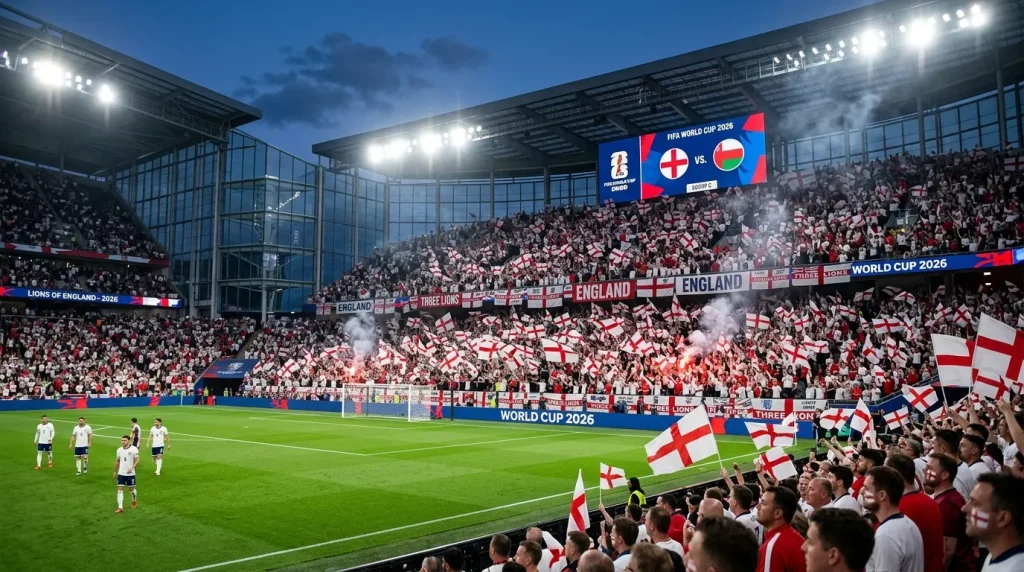
Table of Contents
Walk into any pub in downtown Toronto on a Saturday morning during the Premier League season and you will understand immediately why England matters to Canadian soccer culture. The screens are tuned to Arsenal against Liverpool, the accents at the bar blend Mancunian with Mississaugan, and the emotional investment is indistinguishable from what you would find in Manchester or Liverpool itself. England are not a heritage team for Canadian fans in the way Italy or Portugal are — they are a cultural fixture, woven into the sporting fabric of English Canada through the Premier League’s dominance of the domestic TV landscape. When England play at the World Cup, pubs in Vancouver, Calgary, Ottawa, and Halifax fill up at whatever hour the match kicks off.
That cultural connection makes England one of the most bet-upon teams by Canadian sportsbook users, which creates both opportunity and risk. The betting public tends to overvalue teams they watch regularly, inflating prices on opponents and occasionally compressing England’s odds below fair value. My job as an analyst is to cut through the emotional attachment and assess England at the 2026 World Cup on merit: squad quality, tactical system, group difficulty, and market pricing. Here is what I see.
England’s Path to 2026
European qualification for the 2026 World Cup was expanded to accommodate the 48-team format, with 16 UEFA nations earning direct entry — the largest European allocation in World Cup history. England navigated the process without serious difficulty. Their qualifying group — composed of mid-ranked European sides — was handled with the professional competence that has characterized England’s qualifying campaigns under recent managers. Home wins at Wembley were routine, featuring the kind of controlled dominance that Premier League quality guarantees against overmatched opponents. Away results were solid if unspectacular — England ground out wins and draws in difficult environments without the anxiety that plagued qualifying campaigns in earlier eras. The squad rotation allowed fringe players to gain competitive minutes, building the depth that becomes critical in a 39-day tournament where seven matches is the maximum and fatigue management is as important as tactics.
What matters more than the qualifying results is the trajectory since Euro 2024. England reached the final of that tournament — their second consecutive European Championship final, following the Euro 2020 loss to Italy on penalties at Wembley — and the debate about whether this generation can actually win a major trophy intensified. The Euro 2024 final defeat was a source of both frustration and encouragement: frustration because the squad had the talent to win, encouragement because the pattern of deep tournament runs suggests England are consistently in the conversation at the business end of competitions.
The managerial situation has evolved since Euro 2024. The coaching staff has focused on addressing the recurring criticism of England’s tournament performances — a perceived conservatism in knockout matches, an inability to control possession against elite midfields, and a reliance on individual brilliance rather than systemic creativity. Whether those adjustments have been successfully implemented will only become clear once the tournament begins, but the early signs from friendlies and Nations League matches suggest a more proactive approach to build-up play. England under new tactical guidance look less like a team waiting for something to happen and more like a team trying to make things happen. That distinction matters enormously for bettors analysing match tempo and goal markets.
The squad depth available to the coaching staff is arguably the deepest in the tournament. The Premier League — the most competitive domestic league in the world — produces a surplus of talent at every position, and England benefit from having players who compete against each other at the highest level every week. The challenge has never been talent; it has been cohesion. Can a squad assembled from six or seven different Premier League clubs play as a unit rather than as a collection of individuals? The 2026 World Cup will answer that question definitively.
Squad Preview — The Golden Generation’s Successors
The phrase “Golden Generation” has been used and abused in English soccer for two decades, but the current crop of players genuinely deserves it. The attacking talent available is staggering by any historical standard. Jude Bellingham has matured into a complete midfielder at Real Madrid — scoring goals, creating chances, dictating tempo, and defending with intensity that belies his age. His ability to arrive in the penalty area at precisely the right moment, as he demonstrated with his bicycle kick against Slovakia at Euro 2024, makes him one of the most dangerous players in world soccer. Bellingham is the player England have been waiting for since Gascoigne: a midfielder who can win a match single-handedly.
Harry Kane remains the squad’s most reliable goalscorer. His record for England is extraordinary — well over 60 international goals and counting — and his movement inside the box is among the best in the history of the position. At Bayern Munich, Kane has added a new dimension to his game: deeper playmaking, longer passing, and a willingness to drop into midfield to receive the ball and turn. The criticism that Kane does not perform in finals or big matches is overstated — his tournament record includes goals at multiple World Cups and European Championships — but the trophy drought at club and international level remains a narrative weight that the media will amplify as the tournament progresses.
The wide positions offer an embarrassment of riches. Bukayo Saka, Phil Foden, and Cole Palmer represent three different profiles of wing play: Saka’s direct dribbling and crossing from the right, Foden’s intelligent movement and combination play from the left or central areas, and Palmer’s clinical finishing and composure under pressure. The depth behind them includes players who would start for most other national teams. The question is not who is available but how the coaching staff manages egos, minutes, and tactical roles across a squad where eight or nine players believe they should be starting.
Defensively, England have improved significantly since the 2018 World Cup. The back line features experienced Premier League defenders who are accustomed to high-pressure matches — centre-backs from clubs competing regularly in the Champions League, where the defensive demands mirror those of a World Cup knockout round. The defensive midfield position is covered by multiple options capable of shielding the defence, including players who have mastered the art of positional defending in Pep Guardiola’s Manchester City system and other elite tactical environments. The goalkeeping situation is settled, with a clear first-choice who has performed well in previous tournaments and whose distribution quality suits the coaching staff’s desire to build from the back rather than going long.
The vulnerability, if there is one, lies at full-back — England’s options are good but not elite by the standards of France or Brazil, and against teams with fast, direct wingers, the space behind the full-backs can be exploited. This was evident in the Euro 2024 semi-final and will be a focus for Group L opponents. Croatia, in particular, have the tactical intelligence to target this area, and Joško Gvardiol’s ability to advance from left centre-back into attacking positions could create overloads that England’s right-back must handle alone. The coaching staff’s awareness of this weakness is reflected in the increased emphasis on defensive compactness in recent matches — the full-backs are tucking in more, reducing the space available on the flanks at the cost of some attacking width.
Group L — England, Croatia, Panama, Ghana
Group L is the group that Canadian fans will watch most closely after Group B, because it contains two heritage teams with massive followings in this country. England’s Anglo-Canadian fan base is enormous, and Croatia’s Croatian-Canadian community — concentrated in cities like Toronto, Mississauga, Sudbury, Hamilton, and Vancouver — is passionately invested in their national team. When England play Croatia at the 2026 World Cup, pubs and living rooms across Canada will be divided.
Croatia are the most dangerous opponent in Group L. Their recent tournament pedigree is remarkable: runners-up in 2018, third place in 2022, a consistency at the highest level that few nations can match. The challenge for Croatia is generational transition. Luka Modrić, the midfield genius who orchestrated their runs to the last four in consecutive World Cups, is now 40 years old. Whether he is included in the 2026 squad — and if so, in what capacity — will define Croatia’s tournament. Behind Modrić, players like Joško Gvardiol, Mateo Kovačić, and a new wave of Dinamo Zagreb graduates provide quality, but the loss of Modrić’s influence at its peak would be significant. Croatia’s midfield has always been the engine of their tournament success: Modrić, Rakitić, Brozović, Kovačić — the quartet that carried them to the 2018 final was one of the most technically gifted midfield groups in World Cup history. The 2026 version will not be as strong, but the tactical DNA persists. I expect England to beat Croatia in a tight match decided by one goal, but a Croatian victory is plausible if their transition plan has worked and a younger generation steps up when it matters most.
Panama return to the World Cup for the second time, having debuted in 2018 in Russia where they lost all three group matches and conceded 11 goals. That tournament was a celebration of qualification rather than a competitive campaign — Panama’s first World Cup goal, scored by Felipe Baloy against England, was treated as a victory in itself. Their squad has improved since then, with a more competitive CONCACAF qualifying campaign and better individual talent at the club level, but the gap between Panama and England or Croatia remains wide. Panama will set up defensively, try to stay in matches for as long as possible, and rely on counter-attacks and set pieces for scoring opportunities. From a betting perspective, Panama are relevant only as a handicap and total goals market — the question is not whether they lose to England, but by how many. I expect England to win by three or more goals, which makes the Asian handicap market worth investigating.
Ghana bring pace, physicality, and unpredictability. Their 2022 World Cup campaign included a memorable 3-2 victory over South Korea and a competitive loss to Portugal, demonstrating that they can score goals against good opponents. The Ghanaian squad includes Premier League players and Bundesliga talent, and their attacking output can trouble any defence on a given day. Ghana’s inconsistency is the issue — they are capable of beating Croatia and equally capable of losing to Panama if their concentration drops. For bettors, Ghana matches are high-variance: overs in goal markets and “both teams to score” selections are worth investigating.
Odds and Market Analysis
England’s outright winner odds typically sit between 6.00 and 8.00, making them the first or second favourite in most books alongside France. This pricing reflects the squad depth, the tournament pedigree (semi-finals or better in three of the last four major tournaments), and the favourable group draw. My assessment: England at 7.00 are fairly priced. At 8.00, there is marginal value. Below 6.50, they are overpriced given their inability to actually win a final in recent history. The recurring pattern — deep runs followed by final or semi-final defeats — suggests a team that can beat anyone over 90 minutes but struggles with the specific pressure of a tournament decider. Until England break that pattern, the outright winner market should be approached with caution, and the progression markets (quarter-finals, semi-finals) offer better risk-adjusted value.
Group L qualification odds have England around 1.06 to 1.10 — effectively a certainty. England to win Group L is priced at 1.40 to 1.60, which I think is close to fair. Croatia are good enough to take first place if they beat England head-to-head, but the overall quality advantage favours England across three matches. The more interesting group market is “Group L winning margin” — the gap between first and second place in terms of points — which can be found at some books. If England and Croatia both beat Panama and Ghana, the group will likely come down to the England-Croatia match, and a 1-point gap between them is the most probable outcome.
The semi-final progression market has England around 2.20 to 2.60. England’s likely knockout path takes them through a Round of 32 match against a third-placed qualifier (potentially from Group I or K), followed by a quarter-final against a team from the opposite half of the bracket. If England win the group — which is the most likely outcome — they should face a relatively weak Round of 32 opponent, making the quarter-final the first serious test. The semi-final requires beating another top-tier team, but England’s recent record in quarter-finals and semi-finals (winning both at the 2018 World Cup, reaching the semi-finals at Euro 2020 and Euro 2024) supports the price.
Kane’s goalscoring props deserve special attention. His tournament record is strong — 4 goals at the 2018 World Cup, consistent scoring in subsequent tournaments — and the group stage offers at least two matches (Panama, Ghana) where England should create numerous chances. Kane to score 2+ tournament goals is typically priced around 1.80 to 2.00, and given the volume of opportunities he will receive, this looks like a solid medium-confidence bet. Kane to win the Golden Boot is a longer shot at 8.00 to 12.00, but the expanded 48-team format means more matches and more goals for players on teams that progress deep into the tournament.
The Heritage Angle — England in Canadian Soccer Culture
No national team outside Canada benefits more from the cultural infrastructure of Canadian sports media than England. The Premier League is the most-watched soccer league in Canada by a significant margin, broadcast on every major sports network and streamed on multiple platforms. This means that Canadian bettors know England’s players intimately — they watch them every weekend, they understand their strengths and weaknesses, and they have opinions about squad selection and tactics that are informed by hundreds of hours of viewing.
That familiarity is a double-edged sword. On one hand, it means Canadian bettors can make more informed assessments of England’s chances than they could for, say, Senegal or Uruguay. They know which players are in form, which ones carry injuries, and which tactical setups work against specific opponent types. On the other hand, familiarity breeds emotional attachment, and emotional attachment leads to biased betting. I see this every tournament: Canadian sportsbooks report that England consistently receive a disproportionate share of outright winner bets relative to their probability of winning, which compresses their odds and reduces value. The volume of recreational bets on England from Canadian accounts is second only to Canada themselves. If you want to bet on England, be honest about whether your assessment is analytical or emotional. If it is emotional — if you are backing England because you watched Kane score a hat-trick on Saturday and feel good about his form — that is a legitimate reason to place a bet, but it is not a reason to bet more than you normally would.
The England-Canada connection also creates a unique matchday experience. If Canada and England both progress from their groups, a potential later-round meeting is possible (though the bracket structure makes it unlikely before the semi-finals). The mere prospect of that match — the mother country against the colony, the Premier League’s biggest stars against Canada’s home-grown talent — would generate extraordinary interest across the country. It is not a betting angle, exactly, but it is worth noting: the cultural significance of an England-Canada World Cup match would transcend the sport itself, and the atmosphere at any North American venue hosting it would be unlike anything either team has experienced.
Where England Stand as Tournament Favourites
My prediction for England is a semi-final appearance, consistent with their recent tournament pattern. They have the squad depth to handle the group stage comfortably, the tactical flexibility to adapt to different knockout opponents, and the individual quality — particularly in Bellingham and Kane — to produce match-winning moments under pressure. The question that has defined English soccer for 60 years remains unanswered: can they win the final? I do not know, and neither does anyone else. What I know is that the probability of England reaching the final is around 25%, which is higher than any other team except France. Whether they can convert that opportunity into a trophy depends on variables that no model can capture — penalty kicks, referee decisions, injuries, and the intangible weight of history.
For Canadian bettors, England are best approached through progression markets and player props rather than the outright winner. The value in backing England to beat Panama, to score 2+ goals against Ghana, or to reach the quarter-finals is more reliable than the value in backing them to win the whole tournament. And if you are going to place an outright bet, wait for the odds to drift after a disappointing friendly or an unconvincing group-stage opener — England routinely start tournaments slowly and improve as the rounds progress, which creates buying opportunities for patient bettors.
