
Argentina at the 2026 World Cup — Can Messi’s Champions Repeat?
 Available in US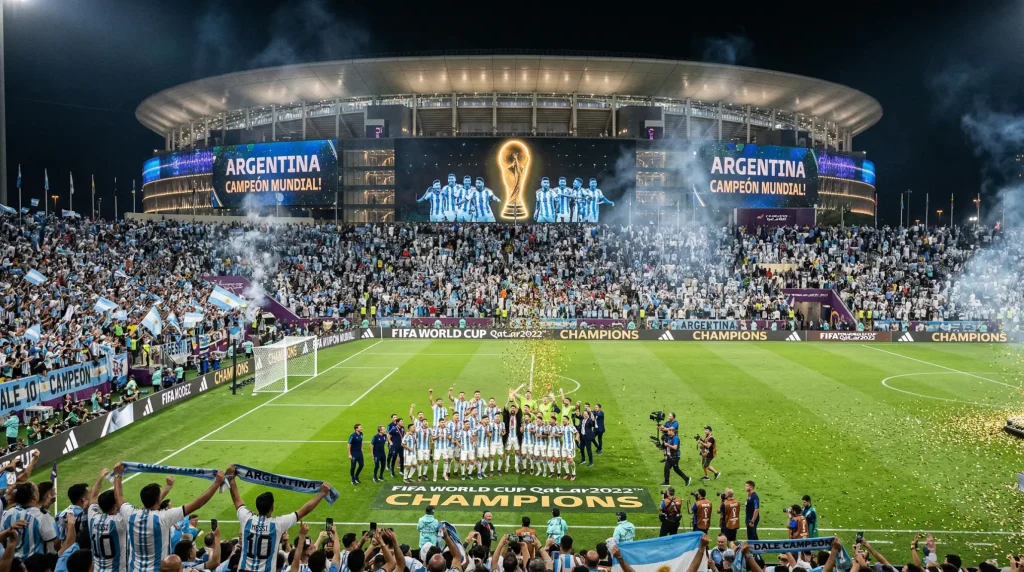
Table of Contents
On December 18, 2022, Lionel Messi lifted the World Cup trophy at Lusail Stadium and completed the one achievement that had eluded the greatest player of his generation. Argentina’s victory over France in what many consider the finest World Cup final ever played — a 3-3 draw settled by penalties after 120 minutes of extraordinary drama — was a moment of pure sporting transcendence. Three and a half years later, the question hanging over this deeply talented squad is both simple and enormous: can they do it again? And can they do it with or without the man who made it all possible?
I watched that 2022 final from a betting perspective, and it reinforced a principle I have held for years: Argentina under Lionel Scaloni are not just talented — they are tactically intelligent, emotionally resilient, and structured in a way that maximizes their best players. The 2026 edition of this team may look different in personnel, but the DNA remains. Argentina at the 2026 World Cup are not coasting on a title defence — they are evolving, and the odds market has not fully grasped the implications.
Argentina’s Qualification and Form
The CONMEBOL qualifying cycle is the crucible that separates genuine contenders from pretenders. Argentina navigated it with the authority of champions. While Brazil stumbled and Uruguay showed inconsistency, Argentina accumulated points with a combination of defensive discipline and clinical finishing that mirrored their World Cup-winning approach. The altitude of La Paz, the heat of Barranquilla, the hostility of Santiago — Argentina faced every environmental challenge South American qualification throws at a team and emerged with their status as continental leaders intact.
Scaloni’s pragmatism has been the defining feature of the qualifying campaign. He does not chase aesthetics. He builds teams that are difficult to beat, that defend their box with ferocity, and that create just enough chances to win matches 1-0 or 2-1. The xG data from Argentina’s qualifiers shows a team that consistently outperforms its expected goals against — meaning they concede fewer goals than the chances they give up would suggest. That is a hallmark of elite defensive coaching and goalkeeper quality, and it translates directly to tournament success. Emiliano Martínez, specifically, has been responsible for a significant portion of that overperformance. His shot-stopping numbers in competitive internationals are among the best in the world, and his command of the penalty area — claiming crosses, sweeping behind the defensive line, organizing the back four — gives Argentina a foundation that other teams spend decades trying to build.
What has changed since 2022 is the squad’s age profile. Several key contributors from Qatar are now in their mid-thirties. Nicolás Otamendi, Ángel Di María (who retired from international duty after the 2024 Copa América), and of course Messi himself have either departed or are approaching the end of their international careers. The transition has not been seamless — Argentina lost the 2024 Copa América semi-final in a match that exposed the gaps left by aging starters — but the core of young, hungry players who served as understudies in 2022 have stepped into larger roles. Enzo Fernández, Julián Álvarez, Alexis Mac Allister, and Cristian Romero are now the spine of the team, and they carry the winners’ mentality forged in Qatar.
The form heading into the tournament is solid but not dominant. Argentina have won more matches than they have lost in the past 12 months, but the margins have been tighter than during the 2021-2023 period when they seemed invincible. For bettors, this creates an interesting dynamic: the market prices Argentina partly on their 2022 pedigree and partly on their current squad quality. If the pedigree premium is too high, Argentina are overvalued. If the market underweights the institutional knowledge of how to win a knockout tournament, they are undervalued. My model puts them in the second category — slightly undervalued at their current outright odds.
Squad Analysis — Post-Qatar Evolution
Lionel Scaloni deserves more credit than he receives outside South America. He took over an Argentina team in crisis after the 2018 World Cup — a squad that had been eliminated in the Round of 16 by France and was fractured by internal politics — and rebuilt it into a Copa América champion (2021), a Finalissima champion (2022), and a World Cup champion (2022). His method is unglamorous: a compact 4-3-3 or 4-4-2 that prioritizes defensive solidity, midfield control, and transitions through the centre. It is not beautiful, but it wins.
Enzo Fernández has emerged as the midfield fulcrum. His ability to receive the ball under pressure, turn, and play forward passes through congested zones is rare for a player his age. At Chelsea, he has had an inconsistent club career, but for Argentina he operates with a freedom and confidence that suggests the international setup suits him better. His partnership with Alexis Mac Allister — who provides energy, pressing intensity, and late runs into the box — gives Argentina a midfield pairing that can compete with anyone in the tournament. The third midfield slot rotates depending on the opponent: a more defensive option against strong attacking teams, a more creative presence against weaker sides.
Julián Álvarez is the striker who does everything. He presses from the front, drops deep to link play, makes diagonal runs behind the defence, and finishes with both feet and his head. His goal in the 2022 World Cup semi-final against Croatia — a solo run that sliced through the Croatian defence — announced him as a player capable of producing tournament-defining moments. At Atlético Madrid, Álvarez has added physical robustness to his game, and at 26 he is entering the peak years of a career that could define Argentine soccer for the next decade. The prop markets around Álvarez — goals, shots on target, anytime scorer — are consistently among the most interesting in any match Argentina play.
Defensively, Cristian Romero is the heartbeat. His aggression borders on recklessness at times — he commits more tactical fouls per 90 than almost any elite centre-back — but his reading of the game and recovery speed mitigate the risk. Alongside him, the centre-back partnership has evolved since 2022, with younger players competing for the spot vacated by Otamendi. The full-back positions feature established options, though none with the attacking output of a peak Marcos Acuña. Emiliano Martínez in goal remains a tournament weapon: his penalty shootout record (decisive saves against France in the 2022 final, against Colombia in the 2021 Copa América) makes Argentina the team you least want to face in a shootout.
The squad’s depth is not as overwhelming as France’s or Brazil’s, but it is sufficient. Argentina’s bench includes players at competitive European clubs who can change the tempo of a match without dramatically altering the system. The key advantage is cohesion: this group has been playing together, in this system, for four years. They know each other’s movements instinctively, which is an advantage that cannot be replicated by a more talented squad assembled from scratch.
The Messi Factor — Will He Play?
This is the question that dominates every conversation about Argentina at the 2026 World Cup, and I wish I had a definitive answer. What I can offer is an analytical framework for thinking about it. Lionel Messi turned 38 in June 2025. He is playing at Inter Miami in MLS, where the physical demands are lower than in European leagues but where the travel schedule — coast to coast across North America — takes a toll on aging joints. His performances for Inter Miami have been characteristically brilliant in bursts: dribbling sequences that defy his age, through balls that only he sees, free kicks that bend into corners with geometric precision.
The question is not whether Messi can still play soccer at an extraordinary level — he can, for 60 or 70 minutes at a time. The question is whether he can sustain that level across a 39-day tournament that could involve seven matches, each against progressively better opposition, in North American summer heat. The physiological data on elite athletes in their late thirties suggests that recovery time between matches increases significantly, which means Messi would likely need to be managed carefully: starting some matches, coming off the bench in others, perhaps sitting out a dead-rubber group game entirely.
From a betting perspective, Messi’s participation creates two scenarios. If Messi plays a significant role (starting at least four of Argentina’s matches and completing at least 60 minutes in each), Argentina’s outright odds should be shorter than they currently are. Messi’s creative output — even at reduced physical capacity — opens spaces for Álvarez and the midfield runners that do not exist when he is absent. If Messi is limited to a bench role or does not participate at all, Argentina’s odds should drift. The team is good enough to compete without him, but they lose the one player who can unlock a defence that has been sitting in a low block for 80 minutes with a single pass.
My working assumption is that Messi will be named in the squad and will play a rotational role — starting in at least two of the three group matches and available off the bench in knockouts. This is the scenario the market is pricing, and I think it is roughly correct. The risk is a pre-tournament injury that rules him out entirely, which would cause a sharp odds movement. If you want to bet on Argentina, consider placing your wager before the squad announcement, when the Messi uncertainty is already baked into the price. A confirmation that he is fit and available will shorten the odds immediately.
Group J — Argentina, Austria, Algeria, Jordan
Argentina could hardly have asked for a more favourable draw. Group J contains no team ranked in the world’s top 20 apart from Argentina themselves, and no team with a strong recent tournament pedigree at the World Cup level. Austria are the most dangerous opponent, but they are a tier below the European heavyweights. Algeria and Jordan are competitive at the continental level but lack the squad depth to threaten Argentina across 90 minutes in a World Cup match.
Austria under Ralf Rangnick have been one of the most improved European teams in recent years. Their pressing game — aggressive, organized, relentless — caused significant problems for France and the Netherlands at Euro 2024. Marcel Sabitzer, Konrad Laimer, and Christoph Baumgartner form a dynamic midfield trio that can disrupt more talented opponents. Austria’s weakness is in the final third: they create transitions and second-ball situations but lack a clinical finisher who converts half-chances into goals. Against Argentina’s organized defence, Austria may struggle to create enough quality to win. This is a match where Argentina’s experience in managing games — absorbing pressure, waiting for openings, punishing mistakes — should prove decisive.
Algeria reached the 2026 World Cup through a competitive CAF qualifying process and bring speed, physicality, and passionate support from a large diaspora across France and North America. Their squad includes players from Ligue 1, the Saudi Pro League, and other competitive leagues, but the overall quality level is a step below Argentina and Austria. The Algeria-Argentina match-up evokes memories of 1982, when Algeria pulled off one of the great World Cup upsets by beating West Germany — but the circumstances are different, and Argentina in 2026 are far better prepared for tournament soccer than Germany were 44 years ago. For Canadian bettors with Algerian heritage — and there is a significant Algerian-Canadian community in Montréal — this group offers an emotional rooting interest, but the betting value on Algeria lies in match-specific props rather than qualification markets.
Jordan are the weakest team on paper, making their World Cup debut after an impressive run through AFC qualification and the intercontinental playoffs. Their 2023 AFC Asian Cup campaign — where they reached the final — demonstrated organizational quality and defensive discipline, but the jump from Asian Cup to World Cup is substantial. Jordan will defend deep, compete physically, and hope for set-piece opportunities. Against Argentina, a 1-0 or 2-0 defeat would be a creditable result. From a betting perspective, the Argentina-Jordan match is an opportunity for large handicap bets if the price is right — Argentina should win by at least two goals, and a three- or four-goal margin is plausible.
Odds and Betting Markets
Argentina’s outright winner odds sit around 7.00 to 8.50, depending on the book and the latest Messi news. This places them alongside Brazil and just behind France and England as joint-second or third favourites. My view: at 8.50, Argentina are a value bet. At 7.00, they are fairly priced. The gap comes down to how you weight their tournament pedigree — a team that has won three of the last four senior trophies they have contested (2021 Copa América, 2022 World Cup, 2022 Finalissima) carries a psychological advantage that models struggle to quantify.
Group J qualification odds have Argentina priced around 1.05 to 1.08, which is essentially a certainty. There is no value in backing Argentina to qualify from this group — the probability is well above 90%, and the odds reflect that. The more interesting markets are Argentina to win Group J (around 1.30 to 1.45) and Argentina’s group-stage points total (over/under 7.5, typically priced close to even). If Argentina win all three matches — which is the most likely single outcome — they finish on 9 points. A draw against Austria and wins over Algeria and Jordan produces 7 points. The over at 7.5 requires a clean sweep, which makes it a coin-flip bet.
The semi-final and final progression markets are where Argentina offer the most compelling value. Argentina to reach the semi-finals is priced around 2.50 to 2.80. Their likely knockout path — a Round of 32 match against a third-placed team from Groups I, J, or K, followed by a quarter-final against a Group K or H winner — is navigable. If Argentina avoid France and England until the semi-finals (which the bracket structure allows), their path to the last four is among the most favourable of the top seeds. My model gives Argentina a 42% chance of reaching the semi-finals, which translates to fair odds of roughly 2.40. Anything above that number is worth backing.
For player props, Julián Álvarez to score 2+ tournament goals is typically priced around 2.00 to 2.30. Across a minimum of three group matches and one or two knockout rounds, Álvarez will play significant minutes as Argentina’s primary striker. His xG per 90 in competitive internationals sits around 0.45, which projects to roughly 2.0 expected goals across 400 minutes of tournament soccer. The over here is a lean, not a conviction bet, but the price justifies the risk.
What Argentina Look Like Without Messi
The 2024 Copa América offered a preview of Argentina without Messi at full capacity. In matches where Messi was substituted early or did not start, Argentina’s attacking patterns shifted noticeably. The team became more direct, more reliant on Álvarez dropping deep and Enzo Fernández driving forward with the ball. The creative burden fell on Mac Allister and the wide players — Ángel Correa, Nicolás González, or whoever occupied the right-wing position. The results were mixed: Argentina could still dominate weaker opponents through sheer quality, but against organized defences, the lack of Messi’s final-third creativity was palpable.
This is the core tension in Argentina’s 2026 campaign. With Messi, they have a player who can produce a moment of genius that no tactical system can defend against — the dribble through three players, the pass that splits a defence, the free kick that curls over the wall. Without him, they have a very good team that relies on collective excellence rather than individual magic. Both versions of Argentina can reach the quarter-finals. Only the version with Messi at something close to his best is a genuine threat to win the tournament.
For bettors, this creates a clear decision point: if the pre-tournament news suggests Messi is fit, motivated, and likely to start, Argentina at 8.00 or above are a strong value play. If the signals point toward a limited role or withdrawal, the value evaporates at anything below 10.00. Monitor the odds in the 48 hours after the squad announcement — that is when the sharpest market movement will occur, and early positioning can capture value that disappears quickly.
Argentina are the defending champions, the team with the deepest recent tournament experience, and the squad best equipped to handle the psychological pressure of knockout soccer. Whether they can repeat depends on Messi’s fitness, Álvarez’s finishing, and Scaloni’s ability to navigate a bracket that will eventually put them face-to-face with France, England, or Brazil. My prediction: Argentina reach the quarter-finals as a minimum, with a semi-final appearance the most likely outcome. A second consecutive title is unlikely but not impossible — and at the right price, that is exactly the kind of bet I am willing to take.
