
MetLife Stadium — Home of the 2026 World Cup Final
 Available in US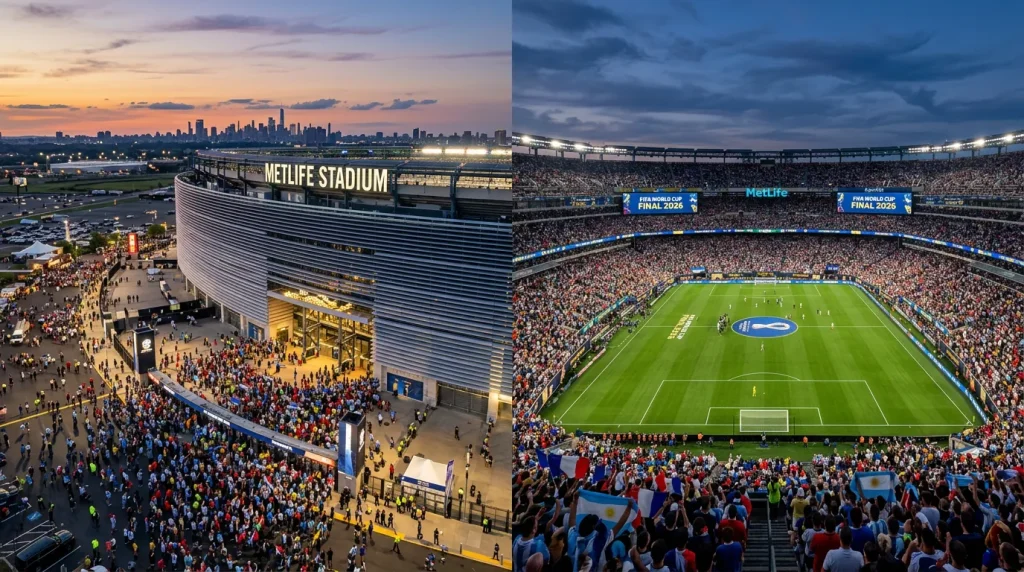
Table of Contents
July 19, 2026. Approximately 87,000 supporters from around the world will file into MetLife Stadium, just across the Hudson River from Manhattan, to witness the crowning of soccer’s new world champion. I have covered World Cups since 2014, and the venue selection for a final always shapes the tournament’s ultimate moment. MetLife Stadium — home of the New York Giants and New York Jets, located in East Rutherford, New Jersey — brings American scale to soccer’s biggest stage. The final will kick off in the New York metropolitan area, broadcast to billions worldwide, with stakes that transform any stadium into hallowed ground.
For Canadian supporters, MetLife Stadium represents the closest World Cup final venue to the country’s population centers. Toronto lies roughly 500 kilometres from East Rutherford — an achievable drive or short flight for the most dedicated fans. If Canada advances through the knockout rounds — a genuine possibility given their Group B draw and home advantage — a path to MetLife could emerge. The mathematics are daunting but not impossible, and understanding the final venue adds context to the ultimate prize.
Beyond the final, MetLife Stadium hosts multiple group stage matches and knockout round fixtures throughout the tournament. The venue’s capacity, infrastructure, and proximity to New York City make it a centerpiece of the American hosting duties. Seven World Cup matches will be contested here, ensuring the stadium remains central to the tournament narrative from opening week through the championship match.
About MetLife Stadium
MetLife Stadium opened in 2010 as a replacement for the historic Giants Stadium, which had hosted the 1994 World Cup final between Brazil and Italy. The new stadium occupies the same Meadowlands Sports Complex site in East Rutherford, New Jersey, maintaining the New York metropolitan area’s status as a major international sporting hub. The venue cost approximately $1.6 billion to construct, making it one of the most expensive stadiums ever built.
The seating configuration for World Cup matches accommodates approximately 87,000 supporters in an open-air bowl design. The stadium lacks a retractable roof — unlike AT&T Stadium in Dallas or SoFi Stadium in Los Angeles — leaving matches exposed to July weather conditions. For the final on July 19, organizers will monitor forecasts closely, though summer rain in the New York area rarely approaches the intensity that would threaten match completion.
The playing surface is natural grass, installed specifically for World Cup matches. MetLife Stadium typically uses artificial turf for its NFL tenants, but FIFA requirements mandate natural grass for tournament fixtures. The conversion process — which involves removing artificial surfaces and installing real grass with supporting infrastructure — has been proven at previous tournaments and club friendlies.
Infrastructure features include modern video displays, extensive concourse areas, and premium seating options throughout the venue. The 2010 construction addressed contemporary stadium requirements, meaning fewer World Cup-specific modifications are needed compared to older venues. Media facilities, broadcast infrastructure, and hospitality areas meet FIFA standards with minimal enhancement.
The Meadowlands Sports Complex location places MetLife Stadium approximately 13 kilometres west of midtown Manhattan. This positioning provides access to New York City’s unparalleled transportation, hospitality, and entertainment infrastructure while keeping the stadium itself in New Jersey. The surrounding area includes parking facilities, adjacent venues, and the American Dream shopping complex.
World Cup 2026 Matches at MetLife Stadium
MetLife Stadium hosts seven World Cup 2026 matches, the maximum allocation for any tournament venue. This schedule includes group stage fixtures, knockout rounds, and the championship match:
| Date | Match | Round | Time (ET) |
|---|---|---|---|
| June 13, 2026 | Group Stage Match (To Be Confirmed) | Group Stage – Matchday 1 | To Be Confirmed |
| June 19, 2026 | Group Stage Match (To Be Confirmed) | Group Stage – Matchday 2 | To Be Confirmed |
| June 23, 2026 | England vs Croatia | Group L – Matchday 2 | 9:00 PM |
| June 25, 2026 | Group Stage Match (To Be Confirmed) | Group Stage – Matchday 3 | To Be Confirmed |
| July 4, 2026 | Round of 16 Match (To Be Confirmed) | Knockout Round | To Be Confirmed |
| July 11, 2026 | Semi-Final (To Be Confirmed) | Semi-Final | To Be Confirmed |
| July 19, 2026 | World Cup Final | Championship Match | To Be Confirmed |
The England versus Croatia group stage match on June 23 provides a marquee fixture for MetLife Stadium before the knockout rounds begin. This rematch of the 2018 World Cup semi-final carries enormous significance for both nations — and for the substantial English and Croatian communities in the New York metropolitan area. The 9:00 PM kickoff creates a primetime atmosphere under the lights.
The July 4 Round of 16 match deliberately coincides with American Independence Day, creating a uniquely American World Cup moment if the United States remains in contention at that stage. The scheduling demonstrates FIFA’s awareness of host nation cultural touchstones.
The semi-final on July 11 and the final on July 19 complete MetLife Stadium’s tournament hosting duties. These matches represent the pinnacle of the 2026 World Cup — the final four teams competing for glory, with the ultimate prize decided on New Jersey soil. The July 19 final will command global attention exceeding virtually any other sporting event that year.
Getting There From Canada
Canadian supporters planning to attend MetLife Stadium matches face multiple travel options depending on origin city, budget, and timeline. The New York metropolitan area receives direct flights from all major Canadian airports, while driving remains viable for those in Ontario and Quebec.
Flying into Newark Liberty International Airport (EWR) provides the most convenient air option for MetLife Stadium. Newark sits approximately 25 kilometres from the stadium, and NJ Transit rail service connects the airport to Secaucus Junction, where the Meadowlands Rail Line provides event-day service directly to the stadium. This combination allows arrival from Canadian cities to stadium entrance in approximately 90 minutes from airport landing.
John F. Kennedy International (JFK) and LaGuardia (LGA) offer alternative New York area airports, though they require longer transit to New Jersey. JFK provides more international flight options and often competitive pricing from Canadian cities. The journey from JFK to MetLife Stadium involves transit through Manhattan and across the Hudson River, adding approximately 45-60 minutes compared to Newark.
Driving from Toronto to MetLife Stadium covers approximately 750 kilometres via Interstate 90 through Buffalo and across New York State. The journey takes 7-8 hours under normal conditions, though border crossings add uncertainty during peak travel periods. Driving provides flexibility for groups and eliminates airport logistics, though New York area traffic and parking costs add complexity upon arrival.
From Montreal, the drive covers roughly 610 kilometres via Interstate 87 through the Adirondacks. This more direct route takes 5-6 hours under normal conditions. The New York State Thruway and Garden State Parkway provide straightforward highway access to the Meadowlands area.
For matches at MetLife Stadium, Canadian supporters should factor accommodation costs into travel budgets. Manhattan hotels command premium pricing, especially during major events. Jersey City, Hoboken, and other Hudson River communities offer more affordable options with PATH train or ferry access to Manhattan. Newark Airport area hotels provide the closest accommodation to the stadium itself.
The World Cup Final — What to Expect
The July 19 World Cup final represents the culmination of 39 days and 104 matches across three countries. Everything the tournament has built toward converges on MetLife Stadium for soccer’s ultimate prize. The atmosphere, stakes, and global attention will exceed anything previously experienced at the venue — including Super Bowls hosted there in 2014.
Final day logistics begin far earlier than kickoff. Security perimeters around the Meadowlands Sports Complex will extend hours before match time. Supporters with tickets should plan to arrive at the stadium area by early afternoon regardless of kickoff time. The final’s precise kickoff will be determined closer to the tournament based on television scheduling and participant nations’ time zones.
The pre-match ceremony will feature FIFA’s full ceremonial program: national anthems, team presentations, trophy display, and opening performances. Previous World Cup finals have included elaborate productions showcasing host nation culture alongside global entertainment acts. Expect the 2026 final to demonstrate American production values at the highest level.
The match atmosphere depends entirely on which nations reach the final. A final featuring Mexico or the United States would create intense home support. European nations bring traveling supporters and substantial diaspora populations from the New York area. South American finalists generate passionate atmospheres through dedicated traveling fans. The neutral supporters present will add to the global celebration regardless of finalists.
Post-match scenes will vary dramatically based on outcome. The trophy presentation, confetti, celebrations, and player interactions with supporters extend well beyond the final whistle. Supporters of the winning nation may remain in the stadium for hours. Departing immediately after the match is nearly impossible — the stadium area processes nearly 100,000 people across surrounding infrastructure.
For Canadian supporters, witnessing a World Cup final provides memories that transcend the participating teams. The magnitude of the occasion — global attention, historical significance, sporting drama — creates experiences worth pursuing regardless of which nations compete. The proximity of MetLife Stadium to Canadian population centers makes attending the 2026 final more achievable than any World Cup since 1994.
Understanding the complete tournament structure, including how the bracket leads to MetLife Stadium, begins with analyzing all twelve World Cup groups and their knockout round implications.
